In reply to @_catinthehat

Cat in the Hat 🐈‍⬛ 🎩 🇬🇧

Cat in the Hat 🐈‍⬛ 🎩 🇬🇧

@_catinthehat · Twitter ·

You can read the full transcript from this meeting held on 3 June 2021 and see how it all played out in this fascinating thread from @1goodtern ⬇️

tern

tern

It starts off with the leads of several groups of healthcare professionals laying out the problem, airborne transmission, how it works, and how it is affecting NHS staff.

Quoted post media Quoted post media Respiratory and eye protection for airborne COVID-19 should be available for all patient-facing interactions in all care settings. Improved ventilation is a must. And to achieve all this, improved collaboration with policymakers as stakeholders for guidance development must now be an accepted method of moving forward.
So, having said that, I would like to hand over to my colleagues who will now give a presentation outlining our case as a basis for further discussion. Thank you.
Microbiology Consultant / FreshAir NHS: And really, just to go through what is underlying our requests and the reasoning for why we are asking for these changes. And it's really predicated on our understanding of aerosol-based transmission, which as you know, there's been a huge amount in both the scientific journals as well as in the media, around a sea change and thinking around this, with the WHO and CDC acknowledging, and indeed, PHE acknowledging, the importance of inhalation transmission of  aerosols. smaller aerosols and not just droplet transmission.
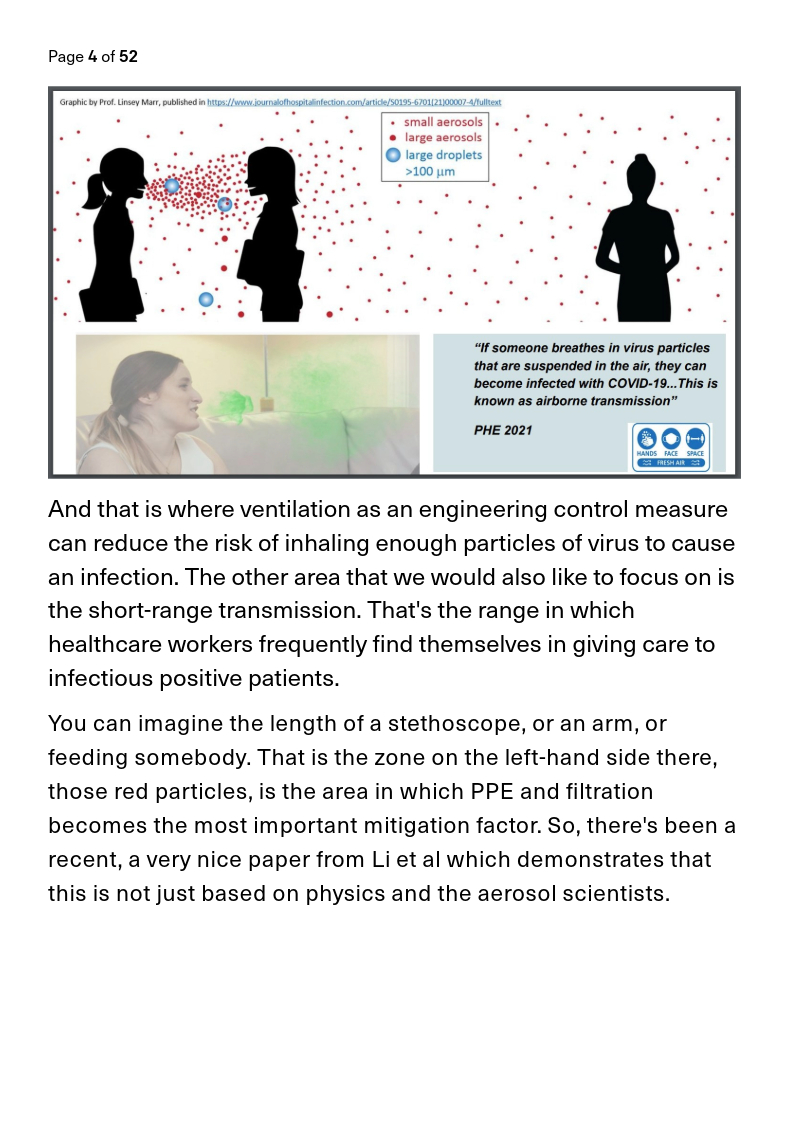
Now, this gives us two opportunities for mitigation that we can optimise to protect healthcare workers. And this is now becoming quite a famous diagram that Professor Lindsay Marr produced, which shows these two situations. And that is where ventilation as an engineering control measure can reduce the risk of inhaling enough particles of virus to cause an infection. The other area that we would also like to focus on is the short-range transmission. That's the range in which healthcare workers frequently find themselves in giving care to infectious positive patients.
You can imagine the length of a stethoscope, or an arm, or feeding somebody. That is the zone on the left-hand side there, those red particles, is the area in which PPE and filtration becomes the most important mitigation factor. So, there's been a recent, a very nice paper from Li et al which demonstrates that this is not just based on physics and the aerosol scientists.