Branko Milanovic
Super interesting.
Arnaud Bertrand
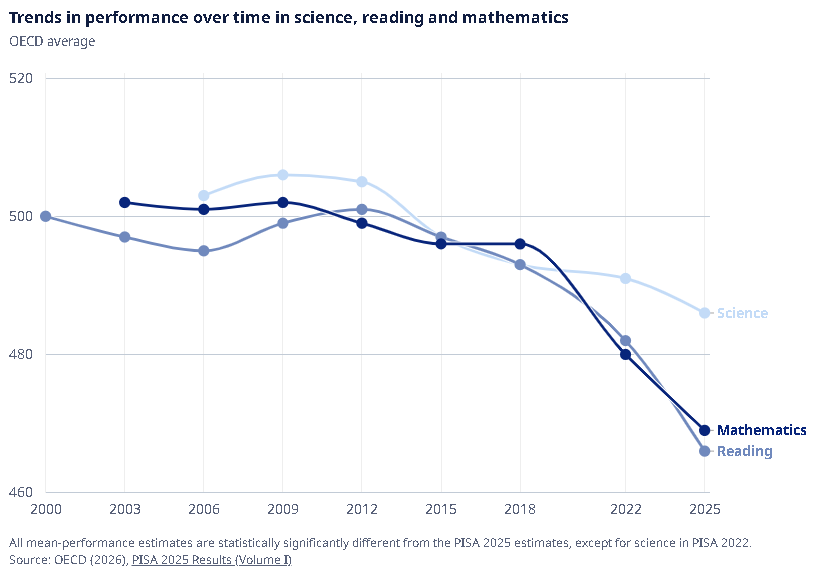
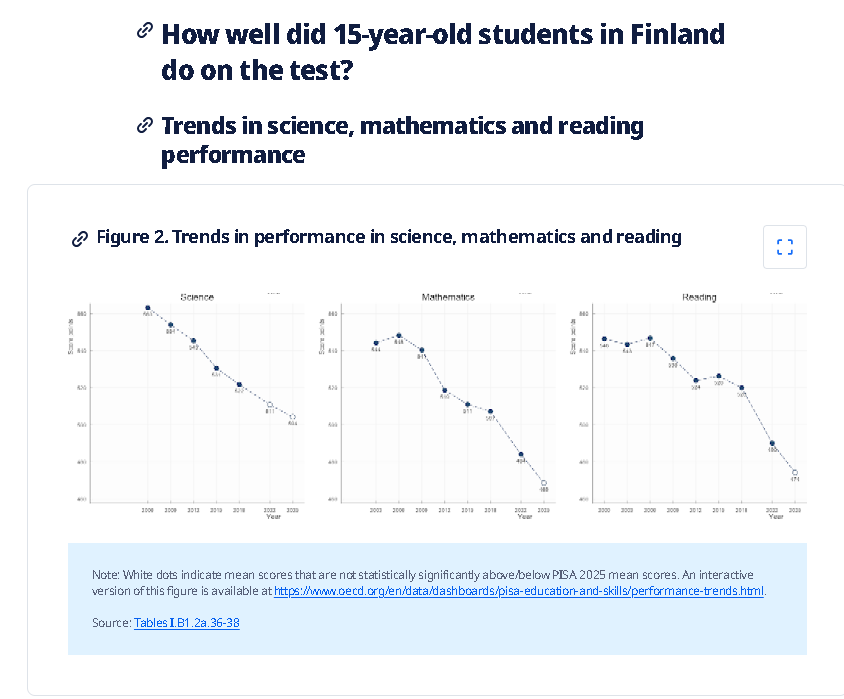
If you really want to understand where the world is at and where it's going, you probably cannot get anything more meaningful than the OECD's PISA study - a global test given every 3 years to an insane 760,000 15-year-olds across 91 countries. No report globally, by any institution, better captures whether countries are building or squandering their future. The latest PISA results just came out yesterday (https://www.oecd.org/en/publications/2026/09/pisa-2025-results-volume-i_5265bfb1.html) and the results are genuinely fascinating, and in some way pretty depressing. Why depressing? Because, sadly, the numbers show that the world is getting dumber: as you can see on the first graph below 👇, since roughly 2012 scores in science, reading, and mathematics have been in continuous decline across OECD countries. The reading score is particularly concerning: it literally cratered, dropping 28 points since 2015, the equivalent of almost 1.5 years of schooling lost according to the report. To make matters even worse, the reading skill that's dropped the most across the board is precisely the one we most desperately need: the capacity to critically assess what you read, cross-reference sources, and tell signal from noise. On average, sadly, 15-year-old kids globally are - more and more - incapable of slowing down and actually thinking about what they're reading. Interestingly though, when you look into the details, this great "dumbing down" isn't across the board: it's overwhelmingly concentrated in wealthy Western countries, while many developing countries are actually getting significantly smarter. For instance rich countries like Finland, the Netherlands, and Norway are in freefall, while countries like Cambodia, Türkiye, and the UAE are posting big gains. To be clear, this doesn't mean that developing countries are now "smarter" than rich ones: save for one notable exception, that's still not the case. But they are catching up fast, both because rich countries are getting "dumber" and because they're themselves getting smarter. The one exception is, as you'd expect, the "smartest" of them all, by a huge margin: China. It is pretty much in a league of its own: just look at the ranking in the table (only kids in Beijing, Shanghai, Jiangsu and Zhejiang got tested - 4 regions covering 200 million people). China's maths results are particularly insane: according to the report, the best level in maths - level 5, where "top performers" begins - starts at 607. The AVERAGE kid in China is 612: "normal" Chinese kids are at a level that is considered elite in the rest of the world. In fact, and that's probably the funniest number in the entire report, look at the column called "Share of low performers in science, reading and mathematics": China is only at 1.8% 😅 Which means that only 1.8% of Chinese kids are rated as low performers in all 3 subjects, almost a rounding error. Even Singapore, the second best and generally considered best-in-class in education, is at 6.8% - almost 4 times worse. My country France, is at 21.3% - almost 12 times worse 😢 All of this - incidentally - dispels the common myth that there would be some kids who are just genetically beyond redemption and simply can't be taught: China proves that with the right system, virtually every child can reach proficiency. So what does this all say about the world and where it's going, besides the fact that, if the future belongs to those who can think, China has never been better positioned to own it? I think the more general picture is this: there is nothing inevitable about any country's trajectory. Finland was the world's education darling fifteen years ago - now it's in complete freefall (see the last graph 👇). Cambodia was at the bottom of every table - now it's posting the biggest gains ever recorded in the study. What changed wasn't the children: it's still Finnish kids (Finland has one of the lowest levels of immigration in the West), and it's still Cambodian kids. It also doesn't matter much - or at least it matters less - if a country is wealthy or not. For instance in Southeast Asia, both Malaysia and Indonesia - the 2 biggest ASEAN economies after Singapore - are faring very badly, while Thailand and Vietnam, both poorer, have better educated kids whose scores are continuing to improve. So that's the final takeaway: the kids don't change, they all have potential, always, as China's 1.8% proved. What does change is what adults decide to do with that potential. It's both hopeful - because it means any country can choose to turn things around at any time - and also sad given the results - because it means so many countries are choosing to fail their children.