Kyle Chan
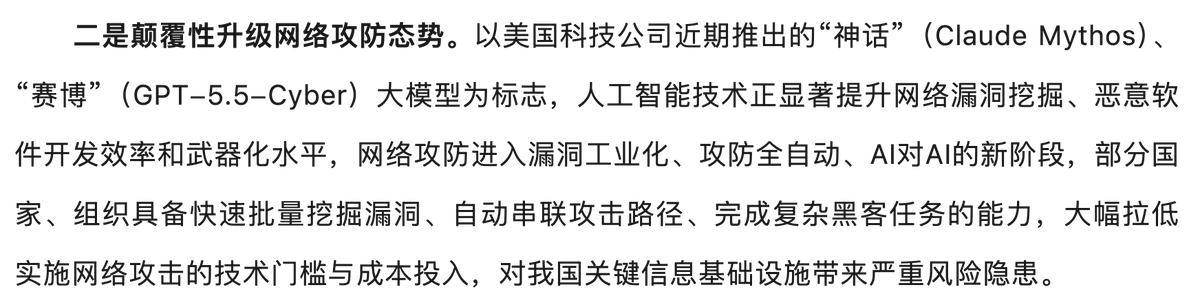
Very important article from the head of China's Ministry of State Security, laying out China's view of top AI risks. First is social & political risk from AI content. Second, is cyber, citing Mythos: "Second, the landscape of cyber offense and defense is undergoing a disruptive transformation. Marked by the recent release of large models such as “Mythos” (Claude Mythos) and “Cyber” (GPT-5.5-Cyber) by U.S. technology companies, AI is significantly improving the efficiency and sophistication of vulnerability discovery, malware development, and cyber weaponization. Cyber conflict is entering a new phase characterized by industrialized vulnerability exploitation, fully automated offense and defense, and AI-versus-AI confrontation. Some countries and organizations are now capable of rapidly identifying vulnerabilities at scale, automatically chaining attack paths, and completing complex hacking tasks—substantially lowering the technical barriers and costs of conducting cyberattacks, and creating serious risks for China’s critical IT infrastructure."

Henry Gao
What are China’s biggest concerns about AI? A new article by Chen Yixin, China’s Minister of State Security, in the latest issue of China Cybersecurity Magazine offers some revealing clues. Chen identifies six major risks: 1. Regime security. Hostile forces and people with ulterior motives can use deepfakes, AI-generated text and images, and automated online accounts to cheaply and massively produce political rumors, spread harmful information, and incite social divisions—waging “public-opinion wars” and “cognitive warfare” against China and directly threatening its political, institutional, and ideological security. 2. Critical infrastructure. AI can enable countries and organizations to rapidly discover vulnerabilities, automatically chain together attack paths, and carry out sophisticated hacking operations, dramatically lowering the technical barriers and costs of cyberattacks against China’s critical information infrastructure. 3. Data leakage. Foreign intelligence agencies can use AI-powered web crawlers, data mining, and profiling to collect sensitive information, including critical national data, trade secrets, and citizens’ personal information. Chinese users who process sensitive information through foreign AI products or export data abroad could also cause large-scale data leaks. 4. Closed technological ecosystems. Countries with advantages in AI theory, model architecture, and computing power may invoke “national security” to impose technology controls, entity lists, monopolize technical standards, and build closed-source ecosystems, restricting other countries’ access to advanced technologies and fragmenting global AI supply chains. 5. Structural challenges to social governance. AI creates new uncertainties for social governance and public order. Algorithmic “black boxes” and data poisoning can amplify existing social biases; misuse of personal information can trigger crises of public trust; automated decision-making creates difficult questions of accountability; and the rapid development of AI is increasingly outpacing existing laws, ethics, and regulatory mechanisms. 6. A fundamental transformation of warfare. AI is pushing warfare into an era of “intelligentization.” Whoever can use algorithms to achieve more precise sensing, judgment, and targeting will gain the initiative on the battlefield. AI is moving from an auxiliary role to a central one in intelligence fusion, decision support, target identification, combat operations, and cognitive warfare. And what is the solution? Chen’s answer is revealing: strengthen “Party control over the internet” and “Party control over data,” and “transform the advantages of Party leadership into the effectiveness of AI governance.” In other words, from the CCP’s perspective, the central question is not simply AI versus no AI. Nor is it even fundamentally a contest between the US and China. It is a contest between the US and the CCP over who gets to control AI, data, information, and ultimately the future of society. And whoever wins that contest will decide the future of humanity. https://mp.weixin.qq.com/s/jsc97cKVYOcHuI_WisvOxw