
In reply to @spiralizing

@timnitGebru (@dair-community.social/bsky.social)

@timnitGebru (@dair-community.social/bsky.social)

@timnitgebru · Twitter ·

@Spiralizing Very close. From a book written in 1963: “The Modeling of Mind: Computers and Intelligence”. With thanks to Matt Grasser on Linkedin who pointed me to this one. I have pages and pages of these going back to the 1940s and tracking the lingo during the hype cycles.
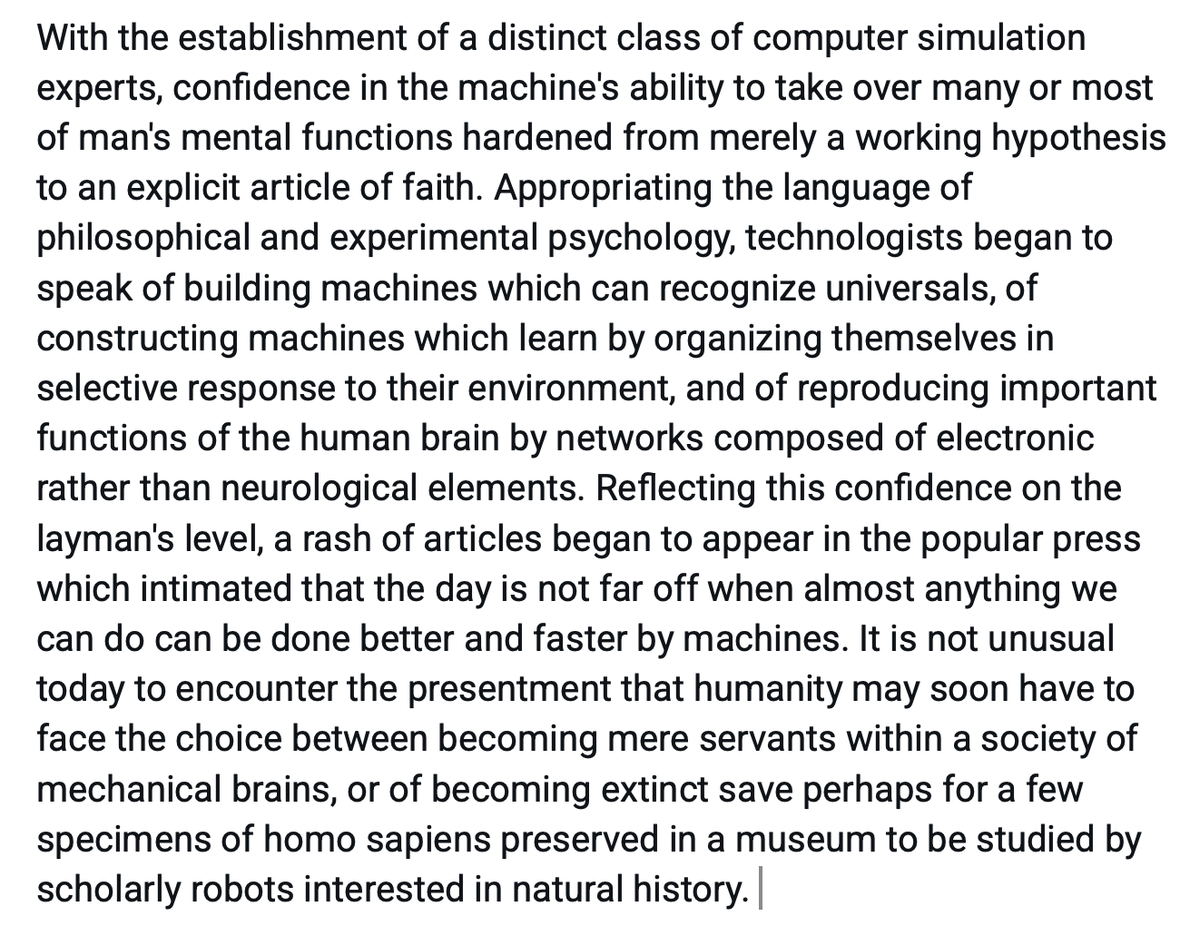
With the establishment of a distinct class of computer simulation experts, confidence in the machine's ability to take over many or most of man's mental functions hardened from merely a working hypothesis to an explicit article of faith. Appropriating the language of philosophical and experimental psychology, technologists began to speak of building machines which can recognize universals, of constructing machines which learn by organizing themselves in selective response to their environment, and of reproducing important functions of the human brain by networks composed of electronic rather than neurological elements. Reflecting this confidence on the layman's level, a rash of articles began to appear in the popular press which intimated that the day is not far off when almost anything we can do can be done better and faster by machines. It is not unusual today to encounter the presentment that humanity may soon have to face the choice between becoming mere servants within a society o